Who uses dating apps? What user data reveals
A first aggregated view of Menta shows who is in the app, who people are looking for, and why identity alone does not explain intent.
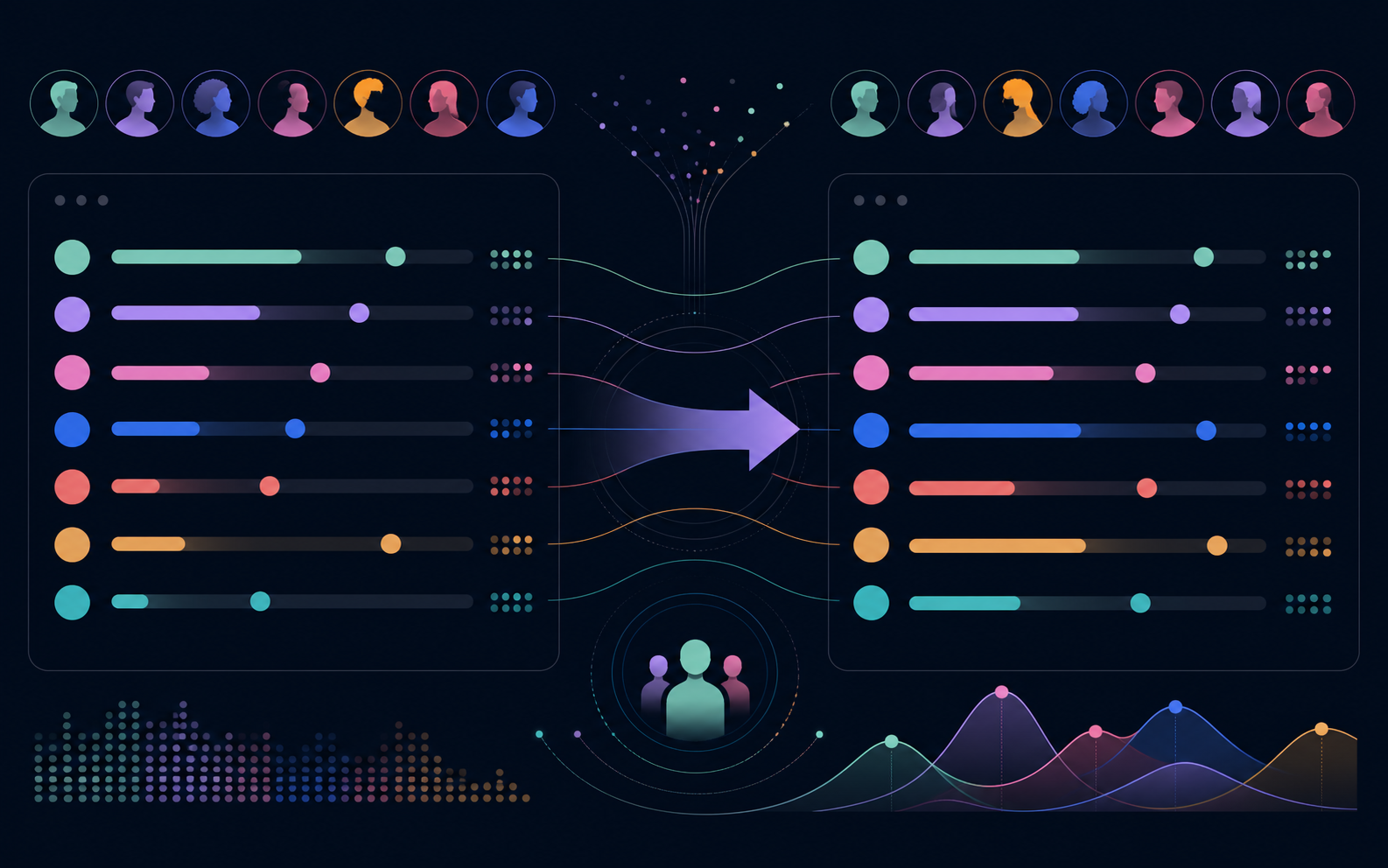
Dating-app users are often described as if everyone wanted the same thing. They do not. Some want a relationship, some want to meet people without defining everything upfront, some want casual connection, and others simply want to expand their social circle.
The more useful question is not only whether apps work. It is who is using them, what people are looking for, and why declared identity does not fully explain search intent.
The short answer
There is no single dating-app user. People with different identities and goals use the same space, and the gap between who is present and who people seek is one of the most useful signals for understanding behavior.
Complete data
Declared identity represents how people identify on the platform. Search interest represents who they indicate they want to find.
| Category | Declared identity | Search interest |
|---|---|---|
| Men | 52,1% | 27,1% |
| Women | 25,9% | 51,3% |
| Gay | 14,7% | 14,9% |
| Lesbian | 2,4% | 2,4% |
| Bisexual | 1,7% | 2,0% |
| Couples | 1,9% | 1,9% |
| Trans people | 1,4% | 0,5% |
Source: Menta Social — aggregated and anonymized data, August 2026.
Key findings
- 52.1% of declared identities on Menta Social are men.
- 25.9% are women.
- 14.7% are gay.
- Women represent 51.3% of search interests.
- Men represent 27.1% of search interests.
- The distribution of declared identity differs from the distribution of search interests.
Source: aggregated and anonymized Menta Social data. Data updated August 2026.
What Menta data shows
In the current aggregated view, men represent 52.1% of declared identity, women 25.9%, gay users 14.7%, lesbians 2.4%, couples 1.9%, bisexual users 1.7%, and trans users 1.4%.
This is not a picture of every dating-app user. It is a view of who is present on Menta now, and it already shows that there is no single app user.
Who someone is and who they seek are different questions
Search interests show women at 51.3%, men at 27.1%, gay users at 14.9%, lesbians at 2.4%, bisexual users at 2.0%, couples at 1.9%, and trans users at 0.5%.
Men represent 52.1% of declared identity but 27.1% of searches; women represent 25.9% of identity and 51.3% of searches. That is not a contradiction. It is the difference between identity and intent.
What research says about online dating
A 2025 Mobile Time/Opinion Box survey found that 23% of Brazilian smartphone users had met someone through a dating app. In the United States, Pew found that 30% of adults had used a dating site or app, and 10% of partnered adults met their current partner online.
These measures are not directly comparable: one measures real-life meetings, another measures lifetime use and how current relationships began. Menta measures composition and search interests inside one app.
Pew also found a divided experience: 53% of American users rated their experience positively and 46% negatively. The honest answer is not that apps work or fail for everyone, but that intent, context, and interaction quality matter.
Two cases the data already reveals
There are no public, authorized user testimonials for this article yet. These are analytical cases from aggregated Menta data, not individual stories or promises.
The first case is the gap between the base and the search: identity composition cannot automatically tell us who people seek. The second is that diversity is not decorative. Different identities and goals require clearer language, privacy, and conversation context.
User volume is not the only useful metric
A large pool does not tell you whether people are nearby, want something similar, answer messages, or have enough context to start a conversation.
A platform can have many profiles and little clarity. Size is a metric, not a conclusion.
- Context: does a profile say more than age and a photo?
- Intent: can you understand what someone is looking for?
- Diversity: is there room for different identities and forms of connection?
- Reciprocity: can a conversation move without one person carrying it?
- Next step: is there a clear, easy-to-decline way forward?
The future of dating apps depends on context
Menta data helps ask better questions: who is seeking whom, which groups are present, and where identity and intent diverge?
No product guarantees compatibility, relationships, or safety. A good experience reduces guesswork without pretending to control human behavior.
About the data and methodology
This analysis uses aggregated and anonymized information from Menta Social. The percentages reflect the distribution observed on the platform during the period analyzed and do not represent a population survey.
No individual user information is presented. For strategic and commercial reasons, Menta Social does not disclose the absolute number of users or the size of the analyzed base.
This analysis is updated periodically to reflect changes observed on the platform.
How to cite these data
Menta Social. “Who uses dating apps? Menta Social data in 2026.” Menta Social, 2026.
When using these data, credit Menta Social and link to this analysis.
Frequently asked questions
Who uses dating apps?
People with different identities, orientations, and goals. Menta data includes men, women, gay, lesbian, bisexual, trans users, and couples in the same space.
Does declared identity show who someone seeks?
Not necessarily. Identity and search interest are related but different dimensions.
Do dating apps still work?
They remain a valid channel for meeting people, but they are not an automatic relationship machine. Context, clarity, and reciprocity matter.
Does Menta data represent all of Brazil?
No. It is a current aggregated view of Menta, shown in percentages, not a population survey.
Meet people with more context
Meet new people with clearer intent, interests, and affinity — without turning a like into a promise.