Bumble, Tinder, or Menta: which app makes sense?
Tinder and Bumble made swiping mainstream. Menta changes the logic: it shows people by affinity, stays transparent, and does not charge to reveal likes and matches.
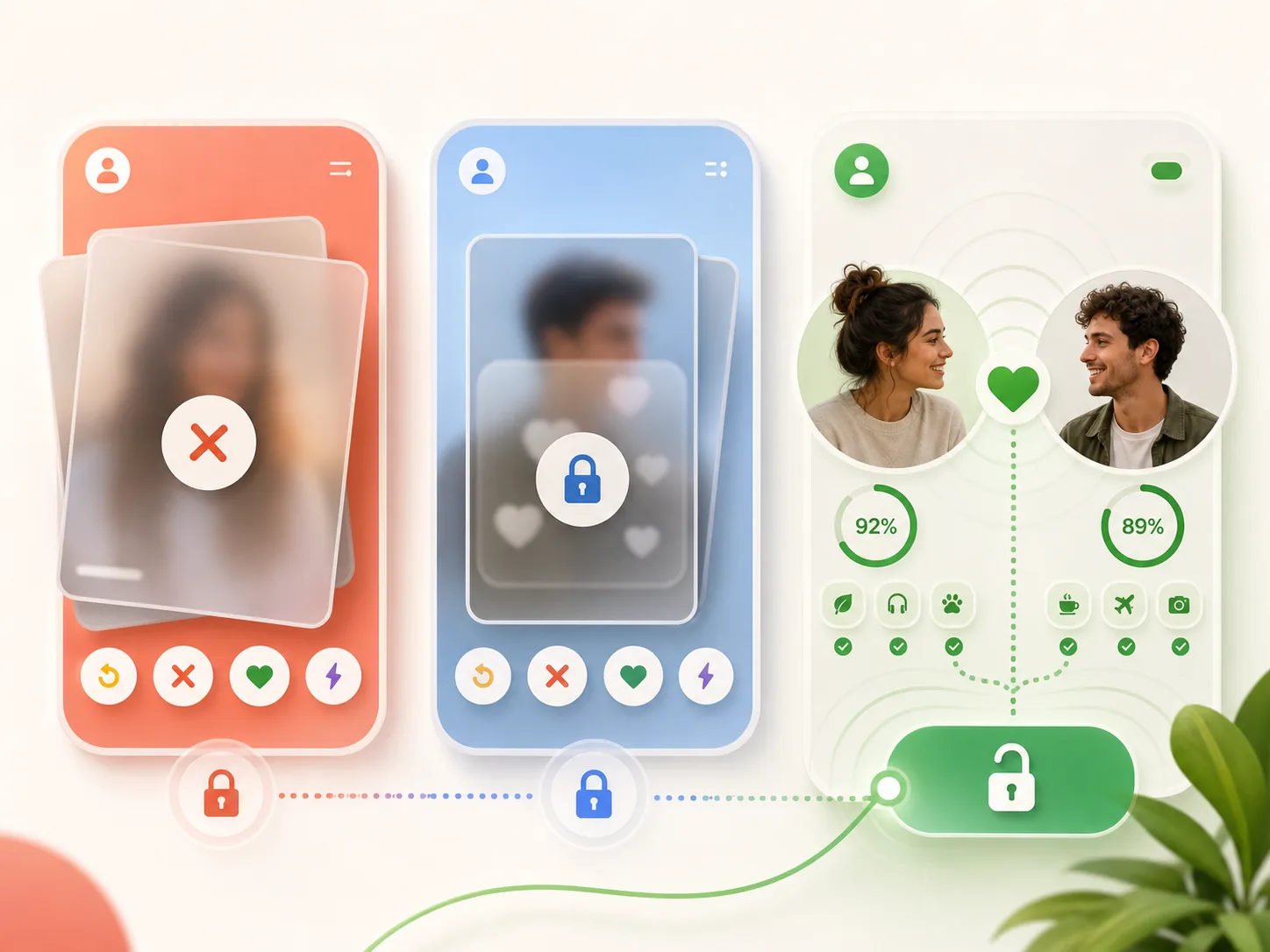
Comparing Bumble, Tinder, and Menta is not just about asking which app has more people. That is the easy question, and not always the useful one. What really changes the experience is how each app decides who appears, how much context it gives you, and how much control you have without running into a paywall.
Tinder and Bumble helped make swiping mainstream. The model is fast, addictive, and easy to understand. But it has a cost: many choices based on photos, fewer signals of affinity, and the constant feeling that the platform knows more than it shows. Menta was built to flip that logic: less game, more clarity.
Which app can replace Tinder?
The best replacement depends on what made you leave. Bumble keeps a familiar profile-discovery experience; Menta focuses on context, affinity, and transparency. Changing the app's name will not change much if the new service repeats the same high-volume swipe model.
01 Tinder: volume, speed, and limited context
Tinder became shorthand for dating apps because it reduced everything to one simple action: swipe. That makes the experience easy to start, but it also pushes people into consuming profiles quickly. You see many people, decide fast, and rarely understand why that person appeared.
For something casual, that may be enough. For a connection with a better chance of becoming a good conversation, the issue appears quickly: the app shows options, but not necessarily affinity.
02 Bumble: a different rule inside a similar model
Bumble introduced an important change by giving women more control over starting conversations in heterosexual matches. That can improve part of the dynamic, especially around safety and reducing bad approaches.
But the base is still similar: sequential profiles, quick decisions, and discovery guided by limited signals. The rule for who starts changes; the logic for finding people through deeper compatibility changes less.
03 Menta: people by affinity, not roulette
Menta starts from another question: who actually fits you? Instead of throwing an infinite feed at you, the experience highlights people by affinity, interests, and compatibility signals. That changes the starting point of the conversation.
If you want to compare with more clarity, take the Menta Social affinity test.
When you understand why someone appeared, the conversation no longer depends only on a good photo or a generic line. There is context. And in dating apps, context saves time and avoids many conversations that start with nothing to say.
Menta’s most important difference
Menta is the only one in this comparison that puts affinity and transparency at the center: it shows people by compatibility and does not charge you to discover who liked you or who matched with you.
Direct comparison
Tinder
- Strong in volume and fast discovery.
- The experience relies heavily on swiping and appearance.
- Visibility and like-related features may sit behind paid plans.
Bumble
- Gives more control over who starts the conversation in some matches.
- Still follows a feed and quick-decision logic.
- Can improve the dynamic, but does not solve affinity by itself.
Menta
- Shows people by affinity and compatibility.
- Is transparent about likes and matches.
- Does not charge to reveal who liked you or to show your matches.
04 Transparency changes trust in the app
A dating app should not turn basic information into artificial mystery. If someone liked you, that is central to the experience. If there is a match, you need to see it. Charging to reveal that kind of information creates a bad feeling: it looks like the platform is holding back clarity to sell anxiety.
Menta’s proposal is more direct. Likes and matches are not treated as premium secrets. People see what matters and decide with more autonomy. That does not guarantee chemistry, of course. No honest app should promise that. But it reduces noise and gives control back to the user.
How to choose between the three
- 1
If you want volume
Tinder is usually the obvious choice for seeing many people quickly, accepting the cost of less context.
- 2
If you want a different opening dynamic
Bumble may make sense if you value its conversation-starting rule and a slightly more controlled experience.
- 3
If you want affinity before the match
Menta is the most coherent choice if you want to understand compatibility before spending energy on random conversations.
- 4
If you want transparency without a toll
Menta stands out because it does not charge to show who liked you or who matched with you. That changes the relationship between user and platform.
The best choice depends on what you accept as normal
If you think it is normal to go through hundreds of profiles to maybe find someone with something to talk about, Tinder and Bumble will feel familiar. If you want a clearer experience, with fewer tricks and more affinity, Menta makes a different choice: show people who fit you better and keep likes and matches visible without turning everything into a charge.
Frequently asked questions
What is the main difference between Menta, Tinder, and Bumble? +
The main difference is that Menta prioritizes affinity and transparency. Tinder and Bumble are better known for swipe-based fast discovery.
Does Menta charge to show who liked me? +
No. Menta’s proposal is not to charge to reveal who liked you or to show your matches.
Are Bumble and Tinder bad? +
Not necessarily. They can work for many people. The point is that their model tends to prioritize volume, speed, and appearance, while Menta prioritizes affinity and clarity.
Does affinity guarantee a relationship? +
No. Affinity does not guarantee chemistry or a relationship. It improves the starting point by giving you more context before the conversation.
Which app is similar to Tinder? +
Bumble is one of the closest alternatives in its profile-discovery format. Menta takes a different route, using more context, affinity, and transparency to help people decide whom to talk to.
What can replace Tinder? +
It may be another app or a mix of apps, communities, and in-person activities. If you want to stay online, choose a platform that addresses why you left Tinder instead of repeating the same swipe somewhere else.
Discover Menta Social
See people by affinity, discover likes and matches with transparency, and start conversations with more context.
Share this comparison